日期:2026/02/08 IAE Frank Chen Chinese
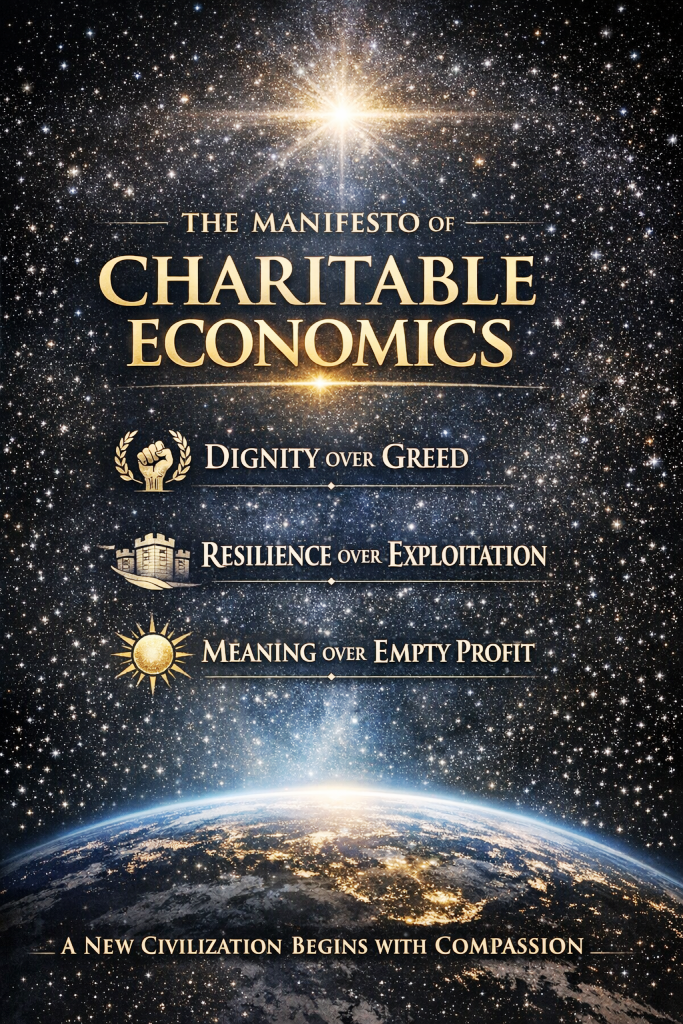
The Manifesto of Charitable Economics
Frank Chen
February 8, 2026
Preamble|Civilization at a Critical Threshold
The economic systems of the modern world have successfully answered the question of
“How to create wealth,”
yet they have consistently failed to answer a far more fundamental one:
“How can civilization endure?”
Capitalism has accelerated production and efficiency.
Welfare economics has attempted to repair inequality.
But under the combined pressures of climate collapse, social fragmentation, technological runaway, and spiritual emptiness, humanity is, for the first time, compelled to confront an unavoidable question:
Is the economy accelerating the self-consumption of civilization itself?
We hereby declare:
The time has come to establish an economic civilization centered on life.
Article I|The Ultimate Utility of Civilization Is Not Wealth, but Survival
We assert:
The highest utility of any economic system is not the maximization of capital,
but the maximization of the continuity of life.
Any form of efficiency that cannot sustain humanity, nature, and future generations is, by its nature, a short-term illusion.
Charitable Economics establishes survival, dignity, wisdom, and continuity as the supreme constraints governing all economic design.
Article II|Charity Is Not a Moral Patch, but a Structural Core
We reject the notion that charity is merely:
-
a donation after success,
-
surplus redistribution after profit, or
-
a post-hoc remedy for defective systems.
Charitable Economics maintains:
Charity must be an endogenous structure of the economic system,
not an external moral narrative.
A truly mature civilization does not rely on the conscience of a few,
but on institutions that make goodness inevitable.
Article III|Value Is Not Defined by the Market or the State Alone
We recognize that:
-
Markets excel at allocating efficiency, but cannot measure the meaning of life.
-
States excel at concentrating resources, but cannot embody long-term civilizational wisdom.
Therefore, Charitable Economics proposes a third path:
Value arises from civilizational consensus;
resources must obey civilizational wisdom.
The economy is no longer merely a system of transactions,
but the material expression of collective civilizational consciousness.
Article IV|Every Economic Act Is a Civilizational Act
Within Charitable Economics:
-
Every investment is a vote for civilization.
-
Every act of consumption is a choice of values.
-
Every institutional design is a commitment to future generations.
We acknowledge:
Human beings are not merely economic agents,
but civilizational lives learning self-awareness.
Article V|Technology Must Serve Compassion and Wisdom
Confronted with digital currencies, artificial intelligence, and quantum technologies,
we refuse to allow technology to become an accelerator of extraction and domination.
Charitable Economics insists:
All advanced technologies must be used
to protect life and extend civilization—
never to exploit the future.
Technology without compassion will ultimately devour the civilization that created it.
Article VI|Civilizational Assets Belong to Humanity and Future Generations
We affirm:
-
Civilizational assets must not be governed by short-term speculation.
-
Long-term value must be protected institutionally.
-
Generations yet unborn possess legitimate economic standing.
Charitable Economics recognizes:
The future is not an asset to be mortgaged,
but a form of life to be safeguarded.
Article VII|The Final Purpose of the Economy Is to Free Civilization from Fear of the Future
When the economy serves only the present, civilization lives in perpetual anxiety.
The ultimate vision of Charitable Economics is:
To build a civilization that does not fear tomorrow—
an economic system capable of taking responsibility for seven generations ahead.
Final Declaration|Our Civilizational Commitment
We do not oppose markets.
We do not deny the role of the state.
We do not reject growth.
We simply declare with clarity:
If the economy cannot protect life,
then the economy itself must be redesigned.
Charitable Economics is not a utopia.
It is civilization’s awakening at the threshold.
Civilizational Manifesto Statement
Resources serve life.
Institutions safeguard the future.
The economy fulfills civilization.
Frank Chen
Founder, Global School of Charitable Economics
February 8, 2026
🌐 www.GCWPA.org
🌐 www.IAEUN.org
🌐 www.GCEDB.org