日期:2026/11/02 IAE
WHITE PAPER ON THE TRANSFORMATION OF GLOBAL HIGHER EDUCATION THROUGH A THREE-TRACK SYSTEM IN THE AI ERA
Institutional Innovation, Academic Value Transformation, High-Level Talent Development, and the Advancement of Global Civilization
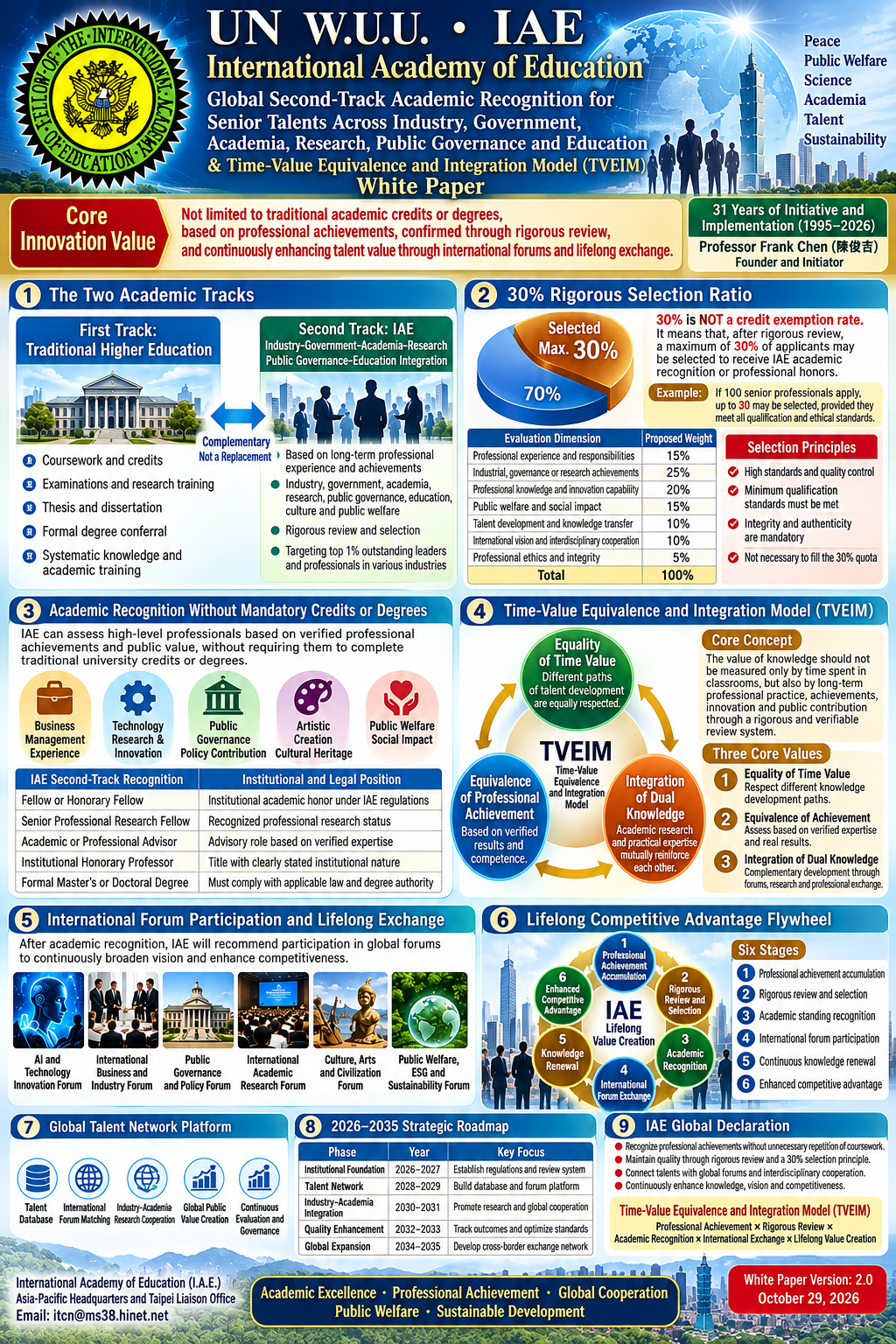
Global Strategic Framework 2026–2035
Track One: Traditional Credit-Based Higher Education and Formal Academic Degree Systems
Track Two: IAE Industry–Government–Academia–Research–Education–Public Governance Academic Recognition and High-Level Talent Development System
Track Three: AI Project-Based Education, Experiential Learning, and Direct Industry Integration — The Horowitz Andreessen Academy (HAA) as an Emerging Case Study
Core Vision:
Knowledge Education × Professional Achievement × AI Innovation × Lifelong Learning × Global Civilizational Advancement
Initiated and Compiled by: Professor Frank Chen (陳俊吉)
Institution: International Academy of Education (I.A.E.)
Date: November 2, 2026
Document Type: Strategic White Paper on Global Education Transformation and Institutional Innovation
EXECUTIVE SUMMARY
Toward a New Global Educational Civilization in the Artificial Intelligence Era
The twenty-first century is witnessing a profound transformation in the ways human beings acquire knowledge, develop professional expertise, demonstrate competence, and create economic and social value.
Artificial intelligence is accelerating scientific discovery, industrial transformation, research productivity, and knowledge dissemination. At the same time, it is challenging conventional assumptions about educational qualifications, professional capability, and lifelong career development.
For centuries, universities have played a central role in developing systematic knowledge, conducting scientific research, cultivating professional talent, and awarding formally recognized academic degrees.
These functions remain indispensable.
However, a single credit-based and degree-oriented pathway should not be regarded as the exclusive means of recognizing all forms of knowledge, professional excellence, innovation, and public contribution.
Outstanding entrepreneurs, scientists, engineers, public administrators, cultural leaders, educators, and philanthropic professionals may develop exceptional expertise through decades of practical experience.
ontributions deserve opportunities for rigorous, transparent, evidence-based evaluation, even when their professional development does not follow conventional academic pathways.
Meanwhile, the rapid advancement of artificial intelligence has encouraged emerging educational institutions to emphasize real-world projects, technological experimentation, industry mentorship, and demonstrable practical capabilities.
This white paper therefore proposes a Three-Track Global Higher Education and Talent Development Framework:
-
Track One — Formal Academic Education: Systematic learning, research training, academic credits, and legally recognized degrees.
-
Track Two — IAE Professional Achievement Recognition: Rigorous evaluation of distinguished professional accomplishments, institutional academic recognition, international collaboration, and lifelong professional development.
-
Track Three — AI Experiential Education: Project-based learning, AI innovation, practical capability development, and direct engagement with technology industries.
These tracks are not intended to replace one another.
They serve different educational and institutional purposes and do not necessarily confer equivalent legal qualifications.
Their integration may establish a more inclusive, innovative, and sustainable global talent development ecosystem.
The central proposition of this white paper is that the future of higher education should move beyond a single-pathway mindset toward a complementary system of academic excellence, professional achievement, technological innovation, and lifelong learning.
CHAPTER 1
WHY THE AI ERA REQUIRES A THREE-TRACK EDUCATION FRAMEWORK
1.1 The Historical Contributions of Traditional Higher Education
For centuries, universities and formal educational institutions have contributed to the development of human civilization through structured teaching, scientific research, academic assessment, and the advancement of specialized knowledge.
Their fundamental contributions include:
-
Systematic knowledge development.
-
Scientific methodology and independent research.
-
Academic quality assurance.
-
Professional ethics and disciplinary standards.
-
Formal qualifications and degree recognition.
-
Preservation and transmission of intellectual traditions.
These achievements remain essential to modern societies.
However, when formal academic credentials become the sole criterion for evaluating all forms of professional knowledge, significant limitations may arise.
First, distinguished professionals with extensive practical achievements but without particular academic qualifications may be undervalued.
Second, rapidly evolving AI technologies can outpace the revision cycles of conventional curricula.
Third, academic knowledge may fail to achieve its full social impact when insufficiently connected to industrial practice, public governance, cultural development, and community needs.
These challenges do not indicate that formal higher education has become obsolete.
Rather, they demonstrate the need for additional educational and professional recognition pathways.
1.2 The Fundamental Philosophy of the Three-Track Model
The proposed framework addresses three distinct questions.
Track One: How Should Knowledge and Research Capabilities Be Systematically Developed?
Traditional higher education provides structured curricula, research training, examinations, and formally recognized academic qualifications.
Track Two: How Should Outstanding Professional Knowledge and Contributions Already Developed Through Practice Be Fairly Evaluated?
The IAE Second-Track Model proposes rigorous institutional recognition of verified professional achievements, ethical conduct, innovation, and public contributions.
Track Three: How Can Emerging Talent Rapidly Develop AI Capabilities Through Real-World Innovation?
Project-based AI educational institutions emphasize practical experimentation, product development, industry mentorship, and direct exposure to technological challenges.
The three tracks together may provide more comprehensive educational opportunities for individuals at different stages of their lives and professional development.
1.3 From a Single Qualification Pathway to a Complementary Talent Ecosystem
The proposed transformation can be summarized as:
Traditional Model:
Formal Learning → Academic Assessment → Degree Qualification → Professional Practice
IAE Second-Track Model:
Professional Achievement → Evidence Verification → Rigorous Evaluation → Institutional Academic Recognition → Lifelong Development
AI Experiential Third-Track Model:
Talent Identification → AI Project Development → Industry Mentorship → Practical Demonstration → Innovation and Career Development
Together, these pathways form a broader system of knowledge development, professional recognition, and technological innovation.
CHAPTER 2
TEN FUNDAMENTAL DIFFERENCES AMONG THE THREE EDUCATION TRACKS
2.1 Comparative Institutional Framework
| Dimension |
Track One: Traditional Higher Education |
Track Two: IAE Recognition Model |
Track Three: AI Experiential Model |
| Core Positioning |
Formal academic education |
Professional achievement recognition |
AI-oriented experiential talent development |
| Primary Participants |
Students and researchers |
Senior professionals and accomplished leaders |
Emerging innovators and technology-oriented learners |
| Knowledge Formation |
Structured courses and academic research |
Long-term professional practice and innovation |
AI tools, experimentation, and real-world projects |
| Admission or Selection |
Academic qualifications and admission requirements |
Verified achievements, competence, and ethical review |
Demonstrated projects, potential, and practical ability |
| Learning Approach |
Courses, laboratories, and research |
Forums, research collaboration, and lifelong exchange |
Projects, mentorship, and industry experience |
| Evaluation Focus |
Academic competence and research performance |
Professional achievements and public contributions |
Demonstrable products and practical results |
| Qualification Outcomes |
Formally recognized academic degrees |
Institutional academic honors and professional recognition |
Project portfolios, experience, and capability evidence |
| Role of AI |
Teaching, research, and assessment support |
Evaluation support and continuing knowledge renewal |
Central learning and innovation technology |
| International Cooperation |
Academic and research networks |
Cross-sector professional and academic networks |
Technology enterprises and entrepreneurial ecosystems |
| Long-Term Mission |
Academic and professional education |
Lifelong development of distinguished professionals |
Accelerated innovation and industry talent development |
This comparison is a conceptual analytical framework proposed in this white paper.
It does not represent an internationally standardized classification formally adopted by all educational institutions.
2.2 The Complementary Value of the Three Tracks
Track One provides academic depth, research methodology, and intellectual foundations.
Track Two recognizes verified professional excellence and facilitates knowledge exchange among experienced leaders.
Track Three accelerates practical innovation and technological capability development.
Their integration may create an intergenerational knowledge ecosystem connecting young innovators, academic researchers, experienced professionals, and public institutions.
Track One develops systematic knowledge.
Track Two recognizes demonstrated professional wisdom.
Track Three accelerates technological experimentation and innovation.
CHAPTER 3
THE IAE SECOND TRACK: THREE DECADES OF ASIAN INSTITUTIONAL DEVELOPMENT AND THE RECONSTRUCTION OF ACADEMIC VALUE
3.1 The Historical Development of IAE in Asia
According to institutional historical information supplied by IAE, its Asian headquarters was established in Taiwan in 1995.
By 2026, this represents approximately thirty-one years of institutional development.
The historical narrative includes the World Peace Conference held in Taoyuan, Taiwan, on August 27, 1996, followed by activities involving international academic exchange, cultural development, public welfare, and cross-sector cooperation.
This historical background may provide an important foundation for examining the development of the IAE Second-Track concept.
Nevertheless, three different historical dimensions must be distinguished:
-
The period of institutional establishment and operation.
-
The period during which professional recognition activities were conducted.
-
The date on which a formally documented Second-Track Academic Recognition System was established.
To substantiate a claim that a complete second-track system has operated for more than thirty years, historical evidence should include institutional charters, evaluation regulations, recognition records, assessment standards, and documented outcomes.
Accordingly, IAE may be described as an institution with more than thirty years of reported organizational development in Asia that advocates a structured second-track approach to recognizing high-level professional achievements.
Any claim of being the world's first such institution should be supported by independent international comparative research.
3.2 The Fundamental Innovation of the IAE Second Track
The central institutional distinction of the IAE model is that accomplished professionals would not be required to repeat conventional university credit programs solely to obtain an appropriate IAE institutional academic honor.
The model evaluates not merely years of employment, but the knowledge, competence, innovations, and contributions demonstrated through professional practice.
Consider a senior semiconductor engineering executive with thirty years of experience.
Such an individual may have accumulated extensive expertise in manufacturing processes, technological innovation, organizational management, patents, and talent development.
Even without a particular doctoral degree, these achievements may justify rigorous professional evaluation and appropriate institutional academic recognition.
IAE could assess such accomplishments under its institutional regulations and confer suitable internal honorary, research, or advisory designations.
However, such recognition would not automatically constitute a legally recognized doctoral degree or confer statutory eligibility for university faculty appointment.
3.3 TVEIM: Time-Value Equivalence and Integration Model
The Time-Value Equivalence and Integration Model (TVEIM) is a proposed conceptual framework for recognizing the knowledge value developed through different educational and professional pathways.
It incorporates three principles.
Principle One: Recognition of Time-Generated Knowledge Value
Knowledge can develop through formal education, professional practice, research, innovation, and long-term social engagement.
The value of such knowledge should be assessed through its demonstrated quality and contributions.
Principle Two: Evidence-Based Competence and Achievement Evaluation
Professional experience should not be converted mechanically into academic credits.
One year of professional employment is not automatically equivalent to one year of university study.
Instead, recognition should be based on verifiable competence, professional outcomes, innovation, and relevant expertise.
Principle Three: Integration of Academic and Professional Knowledge
Academic research and practical professional knowledge should be treated as complementary sources of intellectual and social value.
The objective is not to erase their differences, but to establish appropriate mechanisms for mutual enrichment.
TVEIM seeks to transform the evaluation of time from a purely formal duration-based comparison into an evidence-based assessment of knowledge and achievement.
3.4 The Proposed IAE-STARS High-Level Talent Evaluation Framework
IAE-STARS may serve as a standardized institutional assessment framework for distinguished professional talent.
| Evaluation Dimension |
Proposed Weight |
| Ethics, Integrity, and Professional Conduct |
25% |
| Professional Achievements and Leadership Contributions |
25% |
| Original Research and Innovation Capabilities |
20% |
| Public Responsibility and Social Value |
15% |
| International Influence and Cross-Disciplinary Collaboration |
15% |
| Total |
100% |
These proposed weights require formal institutional adoption before they can be represented as binding evaluation regulations.
The assessment process should include:
-
Documentary verification of professional achievements.
-
Independent expert review.
-
Ethical integrity screening.
-
Conflict-of-interest disclosure.
-
Transparent decision-making procedures.
-
Appeals and reconsideration mechanisms.
IAE may adopt a proposed maximum selection rate of 30% of applicants as an additional quality-control measure.
The 30% figure refers to a proposed maximum acceptance rate, not a 30% academic credit exemption.
Applicants who fail to meet the required standards should not be selected, even if the acceptance ceiling has not been reached.
3.5 Lifelong Talent Development After Recognition
The value of the IAE Second Track should not end with the conferral of an institutional title.
Instead, recognition should become the starting point for continuing professional development.
The proposed process is:
Professional Achievement → Qualification Verification → Academic Review → Institutional Recognition → International Forums → AI-Enabled Knowledge Renewal → Cross-Sector Collaboration → Public Value Creation
Through this process, the IAE Second Track may evolve from a one-time recognition mechanism into a lifelong professional development platform.
CHAPTER 4
THE THIRD TRACK: HOROWITZ ANDREESSEN ACADEMY AND SILICON VALLEY'S AI EXPERIENTIAL EDUCATION MODEL
4.1 An Emerging AI-Era Educational Experiment
In September 2026, Andreessen Horowitz (a16z) announced the development of Horowitz Andreessen Academy (HAA), an emerging educational initiative emphasizing AI experimentation, project-based learning, industry mentorship, and practical innovation.
The initiative provides a useful case study of how educational institutions may develop alternatives to conventional degree-centered pathways.
Its initial program was announced in 2026, with the inaugural cohort planned for 2027.
Therefore, its long-term educational outcomes remain to be established.
4.2 Key Features of the Announced HAA Model
The publicly announced founding-class framework included approximately fifty students, a one-year initial program, and a tuition-free arrangement for the inaugural cohort.
The initiative also described access to substantial AI computing resources, with more than US$50,000 in computing credits per student and additional support for research-related travel.
Andreessen Horowitz announced an investment of approximately US$35 million, with total funding commitments reported at approximately US$42 million.
Technology companies associated with the initiative included NVIDIA, OpenAI, Google, Meta, Anthropic, Anduril, Coinbase, Palantir, Replit, and Stripe.
These figures and arrangements describe the announced initial program rather than independently verified long-term operating outcomes.
4.3 Educational Philosophy: From Academic Credentials to Demonstrable Work
The HAA-type model emphasizes the development of practical capabilities through real-world technological challenges.
Its central principle can be described as:
Proof of Work → Practical Competence → Industry Engagement → Innovation Outcomes
Rather than making formal academic degrees the primary educational outcome, such a model emphasizes:
-
AI project development.
-
Product experimentation.
-
Industry mentorship.
-
Technological problem-solving.
-
Demonstrable portfolios.
-
Entrepreneurial initiative.
-
Direct exposure to professional innovation environments.
This approach may be particularly relevant in technological fields where practical capabilities can be demonstrated through working systems, software, prototypes, or original applications.
4.4 Distinguishing Announced Opportunities from Guaranteed Outcomes
Industry partnerships should not automatically be interpreted as guarantees of employment or internships at particular companies.
Similarly, guest lectures by technology leaders should not be equated with permanent faculty appointments.
The founding-class tuition arrangement should not be assumed to apply to all future programs.
The HAA initiative should therefore be evaluated according to its actual educational implementation, student outcomes, affordability, accessibility, and long-term professional impact.
4.5 Implications for Global Higher Education
The central question raised by the HAA model is:
When artificial intelligence enables individuals to perform complex technological tasks with unprecedented speed, should education provide earlier opportunities for real-world innovation?
Its potential contribution lies in expanding educational pathways that prioritize demonstrable capability, practical experimentation, and direct industry experience.
However, the model also raises questions concerning educational equity, highly selective admission, dependence on corporate resources, and the absence of long-term outcome evidence.
These issues require continued research.
CHAPTER 5
THE COMPLEMENTARY CONTRIBUTIONS OF THE THREE TRACKS TO GLOBAL HIGH-LEVEL TALENT DEVELOPMENT
5.1 A Cross-Disciplinary Talent Development Framework
The greatest potential value of the three-track system is its ability to support individuals with different educational backgrounds, professional experiences, and stages of career development.
| Field |
Track One Contribution |
IAE Track Two Contribution |
Track Three Contribution |
| AI and Semiconductors |
Scientific foundations and engineering research |
Recognition and transmission of senior engineering expertise |
AI product development and technological experimentation |
| Healthcare and Life Sciences |
Formal medical education and research |
Exchange of healthcare leadership and research achievements |
Development of AI-enabled healthcare tools |
| Business and Management |
Management theory and financial research |
Evaluation of corporate leadership and business achievements |
Entrepreneurship and innovative business models |
| Public Governance |
Law, public policy, and administrative research |
Recognition of governance achievements and public contributions |
Digital public-service innovation |
| Culture and the Arts |
Art history and cultural research |
Recognition of cultural preservation and artistic accomplishments |
AI-supported cultural creation and digital preservation |
| Philanthropy and ESG |
Sustainability research and ethical education |
Evaluation of social impact and public welfare achievements |
AI-enabled social innovation |
5.2 An Illustrative Cross-Generational Collaboration
Consider a senior corporate executive with thirty years of management experience.
Through the IAE Second Track, this individual could undergo rigorous evaluation of professional achievements and receive an appropriate institutional honor.
The executive could then collaborate with researchers from a traditional university to develop management case studies.
At the same time, the executive could mentor younger AI entrepreneurs participating in project-based educational programs.
The collaboration would combine:
Academic Knowledge + Professional Experience + AI Innovation
The result could be new educational resources, business innovations, and applied research outcomes.
5.3 A Global Knowledge Transmission Ecosystem
The three-track model may create opportunities for knowledge to move in multiple directions.
Universities contribute theoretical foundations and research methods.
Experienced professionals contribute practical judgment, institutional memory, and leadership experience.
Emerging innovators contribute technological experimentation, new perspectives, and creative applications.
This combination may support continuous knowledge development across generations and disciplines.
CHAPTER 6
FAIRNESS, INSTITUTIONAL CREDIBILITY, AND THE LEGITIMACY OF EDUCATIONAL REFORM
6.1 Educational Innovation and Institutional Resistance
Major educational reforms may encounter resistance arising from legal frameworks, established professional standards, institutional interests, academic traditions, and differences in public understanding.
Traditional universities and professional qualification systems serve legitimate purposes.
Therefore, not every criticism of alternative academic recognition models should be attributed to vested interests.
At the same time, a second-track recognition framework should not be dismissed solely because it differs from conventional credit-based degree education.
Fair institutional evaluation requires evidence, transparency, and clear distinctions among different forms of recognition.
6.2 Three Questions for Evaluating the IAE Second Track
Question One: Does the Second Track Serve a Legitimate Educational and Professional Purpose?
Independent evaluation of distinguished professional achievements can serve a legitimate purpose.
It may complement traditional education by recognizing forms of knowledge and expertise developed through long-term professional practice.
Question Two: Does the Second Track Possess Adequate Institutional Credibility?
Credibility depends on the quality of institutional regulations, evaluation standards, independent reviewers, ethical safeguards, transparent procedures, and documented outcomes.
Institutional history or organizational titles alone are insufficient to establish the reliability of a recognition system.
Question Three: Are Institutional Qualifications Represented Accurately?
Institutional academic honors, professional certifications, legally recognized degrees, and statutory university faculty qualifications must be clearly distinguished.
Recognition under one category should not automatically be represented as equivalent to another.
6.3 Building Credibility Through Evidence Rather Than Institutional Competition
The strongest response to criticism is not competition over titles or institutional prestige.
It is the development of transparent and independently reviewable standards.
IAE can strengthen its Second-Track Model through:
-
Published institutional regulations.
-
Clearly defined recognition categories.
-
Evidence-based assessment.
-
Independent expert evaluation.
-
Ethical and conflict-of-interest safeguards.
-
Transparent appeals procedures.
-
Continuing professional development.
-
Public reporting of measurable outcomes.
The credibility of an alternative academic recognition system must be earned through the quality of its procedures and the value of its results.
CHAPTER 7
AI EMPOWERMENT: FROM TALENT EVALUATION TO GLOBAL KNOWLEDGE CO-CREATION
7.1 Establishing the IAE AI-STARS Evaluation Platform
IAE may integrate its proposed STARS framework with AI-assisted information management and professional evaluation technologies.
Potential platform functions include:
Professional Achievement Database
A structured repository for employment history, research achievements, patents, leadership contributions, professional innovations, and public welfare activities.
AI-Assisted Evidence Verification
Tools for identifying inconsistent information, duplicate submissions, incomplete documentation, and items requiring independent human verification.
Expert Evaluation Management
A system for organizing reviewer assessments, maintaining audit trails, and applying transparent institutional evaluation criteria.
International Forum Matching
Recommendations for academic conferences, industry forums, interdisciplinary research activities, and professional collaboration opportunities.
Lifelong Professional Development Records
Continuing documentation of professional learning, research cooperation, innovation achievements, and public contributions.
7.2 Human Oversight and Responsible AI Governance
AI should function as an evaluation support tool.
It should not independently determine institutional academic recognition through opaque automated decisions.
Applicants should have appropriate opportunities to correct information, request human review, and appeal decisions under established institutional procedures.
The platform should also incorporate data privacy, information security, bias assessment, and transparent accountability.
7.3 The Three-Track Global Knowledge Cycle
The proposed knowledge cycle is:
Academic Research → Professional Application → AI Innovation → New Knowledge Creation → Continuing Education
Track One contributes systematic research.
Track Two contributes professional expertise and institutional knowledge exchange.
Track Three contributes technological experimentation and practical innovation.
Artificial intelligence can support the exchange of knowledge among all three tracks.
The long-term objective is a continuously developing global talent ecosystem.
CHAPTER 8
FIVE CONTRIBUTIONS OF THE THREE-TRACK SYSTEM TO GLOBAL CIVILIZATIONAL ADVANCEMENT
8.1 Technological Civilization: From AI Efficiency to Responsible Innovation
Track One provides scientific foundations and research methods.
Track Two contributes professional judgment and real-world implementation experience.
Track Three accelerates technological experimentation and AI application development.
Together, they may support responsible AI, intelligent manufacturing, energy efficiency, and sustainable digital infrastructure.
8.2 Economic Civilization: From Credential-Based Selection to Diverse Talent Recognition
Evidence-based professional evaluation and project-based education can expand the ways employers and institutions identify talent.
The objective is not to lower standards.
It is to ensure that professional capabilities and measurable achievements receive appropriate consideration alongside formal academic qualifications.
8.3 Social Civilization: Lifelong Learning and Intergenerational Collaboration
Experienced professionals should have opportunities to participate in appropriate academic and professional exchanges regardless of whether they possess a particular degree.
Younger innovators should also have opportunities to demonstrate competence through meaningful practical work.
Collaboration between senior professionals and emerging talent may strengthen knowledge transmission, leadership development, and technological adaptation.
8.4 Cultural Civilization: Integrating Traditional Wisdom with Digital Innovation
Artists, cultural researchers, historians, and AI specialists can collaborate on digital archives, multilingual education, cultural preservation, and research tools.
Such cooperation can help preserve cultural knowledge while expanding its accessibility and relevance in emerging technological environments.
8.5 Philanthropic Civilization: Directing Talent Toward Sustainable Public Value
The three tracks can contribute to environmental, social, and governance initiatives, the United Nations Sustainable Development Goals, public health, educational accessibility, climate technologies, and philanthropic innovation.
However, public value should be evaluated through measurable results.
Relevant indicators may include educational access, beneficiaries reached, research outcomes, environmental improvements, and long-term social impact.
The ultimate value of education lies not only in the qualifications it awards, but also in the knowledge, capabilities, and public contributions it enables.
CHAPTER 9
THE IAE GLOBAL THREE-TRACK DEVELOPMENT STRATEGY, 2026–2035
9.1 Strategic Roadmap
| Development Phase |
Period |
Proposed IAE Strategic Actions |
| Institutional Framework Development |
2026–2027 |
Formalize Second-Track regulations, STARS assessment, selection principles, and qualification distinctions |
| Talent Platform Development |
2028–2029 |
Establish AI-assisted professional achievement databases and international talent exchange networks |
| Three-Track Collaboration |
2030–2031 |
Develop cooperation with universities, research institutions, and AI experiential education platforms |
| Quality Assurance and Outcome Evaluation |
2032–2033 |
Publish professional development, research collaboration, and public contribution reports |
| International Expansion |
2034–2035 |
Promote cross-border comparative research, international forums, and lifelong knowledge exchange |
This roadmap is a strategic proposal, not a statement that participating institutions have already agreed to the activities described.
9.2 Three Priority International Cooperation Mechanisms
Priority One: Collaboration with Traditional Universities
IAE-recognized senior professionals could participate in guest lectures, industry case studies, applied research, and talent development activities, subject to the regulations and requirements of participating universities.
This would allow professional experience to enrich academic learning.
Priority Two: Collaboration with AI Experiential Education Platforms
Senior industry leaders could serve as project mentors for emerging AI innovators.
Their contributions could include strategic management, professional ethics, market understanding, governance, and practical problem-solving.
Priority Three: Establishment of a Global Public Value Research Network
Through international forums and collaborative research, professional expertise could be translated into measurable contributions to technology, education, cultural development, and sustainability.
9.3 Recommended Performance Indicators
The implementation of the IAE framework should be assessed through indicators such as:
-
Number and quality of independently reviewed professional recognition cases.
-
Reviewer independence and ethical compliance.
-
International academic and industry collaborations.
-
Research publications and professional case studies.
-
Participation in continuing education.
-
Mentorship and knowledge-transfer outcomes.
-
AI-enabled innovation projects.
-
Documented public welfare and sustainability contributions.
Institutional success should be measured by quality and impact rather than by the number of titles awarded.
CHAPTER 10
THE IAE GLOBAL THREE-TRACK EDUCATION AND CIVILIZATIONAL ADVANCEMENT DECLARATION
A New Global Vision for Higher Education in the Artificial Intelligence Era
TRACK ONE
Academic Education as the Foundation of Knowledge and Scientific Research
Traditional higher education provides structured learning, intellectual discipline, research capabilities, and formal academic qualifications.
TRACK TWO
Professional Achievement as the Foundation of Institutional Recognition and Lifelong Value Development
The IAE Second Track emphasizes verified professional accomplishments, ethical integrity, rigorous evaluation, appropriate institutional recognition, international exchange, and continuing professional development.
TRACK THREE
AI Experiential Learning as an Accelerator of Future Innovation
Project-based AI education encourages practical experimentation, technological creativity, industry engagement, and demonstrable capabilities.
10.1 The Shared Global Mission
The three tracks should not be regarded as competing systems in which one must eliminate the others.
They can instead contribute to a broader educational ecosystem built upon complementary strengths.
Academic Knowledge × Professional Achievement × AI Innovation × Lifelong Learning
Their common objective is to cultivate individuals who possess intellectual depth, practical competence, innovative capabilities, ethical responsibility, and a commitment to public value.
10.2 The IAE Three-Track Global Education Declaration
Academic Excellence as the Foundation.
Professional Achievement as Evidence of Competence.
Artificial Intelligence as an Engine of Innovation.
Integrity and Rigorous Evaluation as the Basis of Credibility.
International Cooperation as the Bridge Between Knowledge and Practice.
Lifelong Learning as the Foundation of Continuous Development.
Public Responsibility and Sustainability as the Ultimate Civilizational Mission.
FINAL CONCLUSION
FROM A SINGLE DEGREE-CENTERED MINDSET TO A THREE-TRACK GLOBAL EDUCATIONAL CIVILIZATION
The most important transformation of higher education in the AI era is not the elimination of traditional universities.
Nor is it the replacement of formal academic qualifications with institutional honors or technology-based training programs.
The essential transformation is the recognition that human knowledge, professional competence, and innovation can develop through different pathways.
Track One ensures academic depth and research quality.
Track Two recognizes distinguished professional achievements and supports lifelong value development.
Track Three accelerates AI experimentation and practical innovation.
Together, these tracks may contribute to a more inclusive, rigorous, adaptive, and sustainable global education system.
For IAE, the long-term opportunity lies in transforming decades of institutional experience and professional exchange into a clearly documented framework for independent evaluation, transparent recognition, international collaboration, lifelong learning, and measurable public contribution.
The value of the IAE Second Track should not be measured merely by the number of institutional academic titles conferred.
It should be measured by the research, innovation, professional knowledge transfer, educational opportunities, and social contributions created by recognized individuals after receiving institutional recognition.
THE CENTRAL PROPOSITION
Educational fairness in the twenty-first century does not mean granting everyone the same degree.
It means ensuring that individuals who develop knowledge and competence through different pathways have opportunities for appropriate, credible evaluation and continuing development.
The future of global education should therefore move toward:
THREE TRACKS · COMPLEMENTARY VALUES · AI EMPOWERMENT · LIFELONG DEVELOPMENT · GLOBAL CIVILIZATIONAL ADVANCEMENT
Knowledge Education × Professional Achievement × AI Innovation × Lifelong Learning × Sustainable Public Value
RESEARCH AND INSTITUTIONAL CLARIFICATIONS
This white paper proposes a conceptual Three-Track Global Education Framework for comparative research and institutional development.
The classification is not presented as an internationally standardized education system.
Historical claims concerning IAE's institutional development, the continuous operation of its Second-Track recognition practices, and any claim of global pioneering status require supporting institutional documentation and independent comparative verification.
The IAE-STARS evaluation weights, proposed maximum 30% acceptance rate, and 2026–2035 development roadmap are institutional proposals unless and until formally adopted and implemented.
IAE institutional academic honors and professional designations must remain clearly distinguished from legally recognized academic degrees, professional licenses, and statutory university faculty qualifications.
The Horowitz Andreessen Academy is discussed as an emerging educational initiative announced in 2026, with its inaugural program planned for 2027. Its long-term educational effectiveness remains subject to future evidence.
The three tracks perform different functions and do not automatically confer equivalent legal or academic qualifications.
SELECTED REFERENCES AND DOCUMENTATION FOR FURTHER VERIFICATION
-
International Academy of Education (I.A.E.). Global Second-Track Academic Recognition and Industry–Government–Academia–Research Leadership White Paper. Institutional proposal, October 2026.
-
International Academy of Education (I.A.E.). Time-Value Equivalence and Integration Model (TVEIM). Institutional conceptual framework, 2026.
-
Andreessen Horowitz (a16z). Public announcements concerning Horowitz Andreessen Academy, September 2026.
-
Horowitz Andreessen Academy. Published information concerning the founding-class educational model, admissions, project-based learning, and industry engagement, 2026.
-
UNESCO. Reimagining Our Futures Together: A New Social Contract for Education. 2021.
-
UNESCO. Guidance for Generative AI in Education and Research. 2023.
-
OECD. OECD Skills Outlook 2023: Skills for a Resilient Green and Digital Transition. 2023.
-
United Nations. Transforming Our World: The 2030 Agenda for Sustainable Development. 2015.
Institutional historical materials and HAA program details should be checked against original documents before formal international publication.
INTERNATIONAL ACADEMY OF EDUCATION (I.A.E.)
Global Three-Track Higher Education and Civilizational Advancement Initiative
2026–2035 Strategic White Paper
Professor Frank Chen (陳俊吉)
November 2, 2026
KNOWLEDGE · PROFESSIONAL EXCELLENCE · ARTIFICIAL INTELLIGENCE · LIFELONG LEARNING · GLOBAL SUSTAINABILITY