日期:2026/01/15 IAE
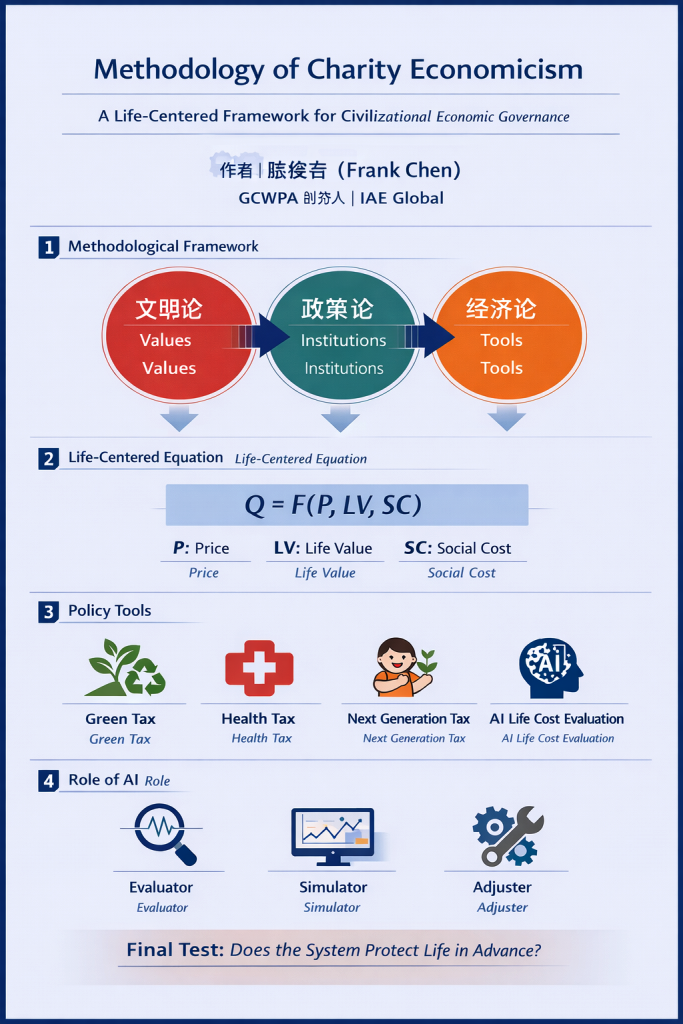
Methodology of Charity Economicism
A Life-Centered Framework for Civilizational Economic Governance
Author:
Frank Chen
Founder, Global Charity Economicism (2007-2018)
GCWPA | IAE Global
《慈善經濟主義》方法論章——完整英文正式译文,定位为 Academic / UN Policy / Think Tank Official English Edition。
-
✔ Complete, faithful, and unabridged
-
✔ Suitable for academic, UN, and think-tank use
-
✔ Terminology aligned with global governance discourse
-
✔ Fully consistent with the original Chinese methodology chapter
1. Methodological Positioning
Charity Economicism is not an ideological manifesto, nor a moral appeal.
It is a governance-ready methodological framework designed to resolve a foundational contradiction of modern civilization:
How can economic rationality be reconciled with the preservation of life, rather than standing in opposition to it?
Accordingly, the methodology of Charity Economicism is constructed to be:
It functions simultaneously across three inseparable levels:
-
Civilizational
-
Policy
-
Economic
2. Foundational Methodological Assumptions
Charity Economicism rests on five core assumptions:
Assumption 1: Life Value Is Economically Measurable
Life, survival, health, mental well-being, and intergenerational continuity are not merely ethical concepts; they are quantifiable costs and utilities that can be incorporated into governance systems.
Assumption 2: Price Is Not a Final Variable
Price is a tool of allocation, not a source of civilizational legitimacy.
Efficiency alone does not justify outcomes that erode life.
Assumption 3: Social and Life Costs Must Be Internalized
All externalized life and social costs eventually reappear as public fiscal burdens and civilizational risks.
Assumption 4: AI Makes Precision Accounting Possible
The historical exclusion of life costs is no longer due to technical limitations.
With AI and big data, exclusion becomes a policy choice, not a necessity.
Assumption 5: Civilization Must Be Subject to Failure Criteria
Any system that allows life to be delayed, degraded, or sacrificed due to price or efficiency considerations must be regarded as civilizationally deficient.
3. The Trinity Methodological Framework
Charity Economicism adopts a non-decomposable trinity structure:
Civilization (Purpose)→Policy (Institutionalization)→Economy (Instruments)
Methodological Implications:
-
Civilization defines normative legitimacy
-
Policy translates values into collective responsibility
-
Economy provides efficient allocation tools
Any attempt to reform only one layer inevitably fails.
4. Life Value as the Core Variable
Traditional Price-Centered Model
Q=F(P),P=AR=MR=MC
This model is efficient and calculable, yet systematically excludes life costs.
Life-Centered Model of Charity Economicism
Q=F(P,LV,SC)
Where:
-
LV (Life Value): life-preserving utility
-
SC (Social Cost): environmental, health, and societal costs
The methodological shift is decisive:
Life moves from an externality to a core independent variable.
5. Operational Tools of Life Value Economics
Charity Economicism employs the following analytical tools:
(1) Life Value Function
Measures the net impact of economic activity on life conditions.
(2) Life Value Utility
Evaluates how incremental consumption or policy change affects life quality.
(3) Marginal Utility of Life Value
-
Self-interest-driven consumption → diminishing marginal life utility
-
Altruistic, preventive, and life-centered activities → increasing marginal life utility
(4) Life Value Time-Delay Analysis
Quantifies life loss caused by price- or system-induced delays in access.
6. Policy Methodology: From Remediation to Prevention
At the policy level, Charity Economicism adopts:
-
Prevention-First Principle
-
Internalization of Life Responsibility
-
Intergenerational Weighting
Policy instruments include:
-
Green environmental taxes
-
Health quota taxes
-
Intergenerational life protection taxes
-
AI-based life cost assessment systems
7. Economic Methodology: Markets with Life Boundaries
Charity Economicism is not anti-market.
Markets, profits, competition, and innovation remain essential.
However:
Profit is legitimate only after life and social costs are fully deducted.
Markets operate within life-preserving boundary conditions, rather than overriding them.
8. AI as a Methodological Enabler
AI plays three essential roles:
-
Evaluator: quantifies life, health, and environmental impacts
-
Simulator: forecasts medium- and long-term life outcomes of policy choices
-
Adjuster: dynamically recalibrates institutional parameters
AI does not replace ethical judgment,
but renders ethical neglect impossible.
9. Verification Criterion
Charity Economicism applies a single, decisive verification test:
After a system operates, is life being protected earlier—or postponed further?
10. Methodological Boundaries and Self-Restraint
This framework explicitly acknowledges:
-
Not all life value can be fully quantified
-
AI cannot replace human moral responsibility
-
Governance must remain transparent and democratically accountable
The objective is not to control life,
but to prevent institutionalized neglect of life.
11. Concluding Methodological Statement
The ultimate methodological contribution of Charity Economicism is this:
For the first time, civilization itself becomes
a system that can be measured, corrected, and governed—
with life as its highest constraint.